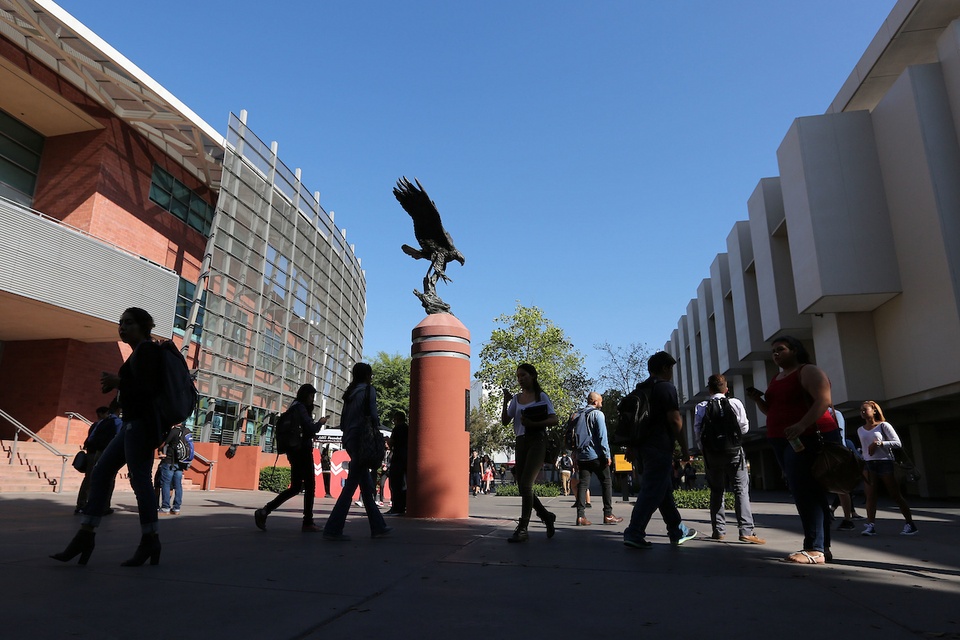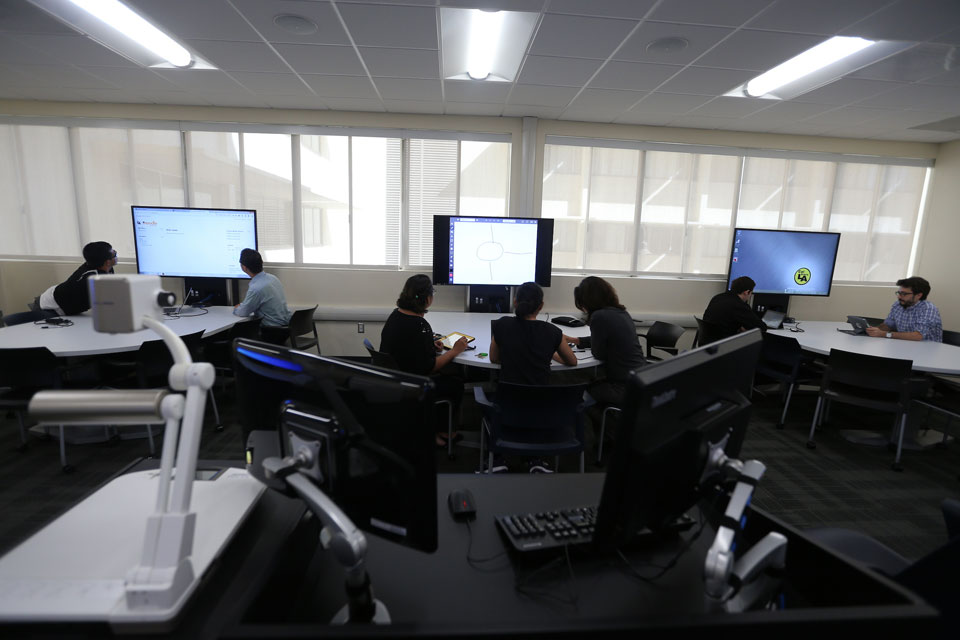
Cal State LA showcased the work of its community college summer interns as it hosted the inaugural “Building Bridges to STEM Careers Expo” on Friday, August 1.
The event, which was co-sponsored by Growth Sector and Caltrans, highlighted the early accomplishments of the STEM Core Engineering Degree Apprenticeship Pathway, an initiative that encourages community college students to complete bachelor’s degrees in engineering and pursue high-wage, high-growth careers in science, technology, engineering, and mathematics (STEM).
The expo welcomed about 40 interns, their Cal State LA student mentors, faculty, public sector leaders, and employers. Also in attendance were about 70 students from Los Angeles City College (LACC), East Los Angeles College (ELAC), and Los Angeles Mission College, who, as members of the Summer Bridge program, could potentially serve as future interns.
“The interns are in the early stages of their academic careers but are able to participate in hands-on experiences under the guidance of our own students and faculty advisors,” said Charles Liu, chair of the Department of Electrical and Computer Engineering. “It’s a very immersive environment that informs them of what is expected in the real world.”
The expo culminated with the interns exhibiting their research and experiments of the past two months. They explained their processes and findings to the Summer Bridge students through storyboards and demonstrations.
Blake Allard, an incoming sophomore at Saddleback College, supplemented his posterboard presentation with animation and a video of himself explaining his “SmartHeart” project, a heartrate and blood monitoring app that stores readings in the cloud. He also provided the aspiring interns with some encouragement.
“Everybody who came by my poster seemed very intrigued,” said Allard, who plans on majoring in computer science. “I had great conversations with students who seemed genuinely interested. I was adamant that it was doable, because if I can do it anybody can.”
The STEM Core Engineering Degree Apprenticeship Pathway is a national program led by Growth Sector. It addresses educational inequities and workforce gaps by supporting community college students, especially those from underrepresented backgrounds, through academic assistance, mentoring, and paid work experiences.
The pathway participants begin by joining the Summer Bridge program, where, as freshmen, they participate in STEM workshops at their respective community colleges. They are placed in paid internships at four-year colleges during their second year and then apprenticeships in their third year.
“Our students are getting early work experience,” said Gabe Hanzel-Sello, Growth Sector’s national STEM director. “Traditionally, most engineering undergrads get internships maybe following their sophomore or junior year at university. We’re subsidizing interns after their first year at community college with the idea that they graduate with a ton more experience than many of their counterparts.”
At Cal State LA, the second-year students serve their internships under the Summer Making, Academic Prep, and Research for Transfer Students (SMART) program.
Incoming LACC sophomore William Duran studied artificial intelligence, game development, robotics, and electrical work during his internship. For his project, he built an app that detects hazardous gases and fire. Duran said the internship helped him narrow his career path. He was previously interested in cybersecurity but now wants to focus on artificial intelligence and machine learning when he enrolls at Cal State LA as a junior.
“It was great,” Duran said of the internship. “I was able to talk to a lot of people in the major and people in the department. I was able to make connections, and I learned a lot of skills.”
Said Allard, “The internship was amazing. There were so many real-world scenarios that I feel like we would never get in a regular academic course. That experience was invaluable.”
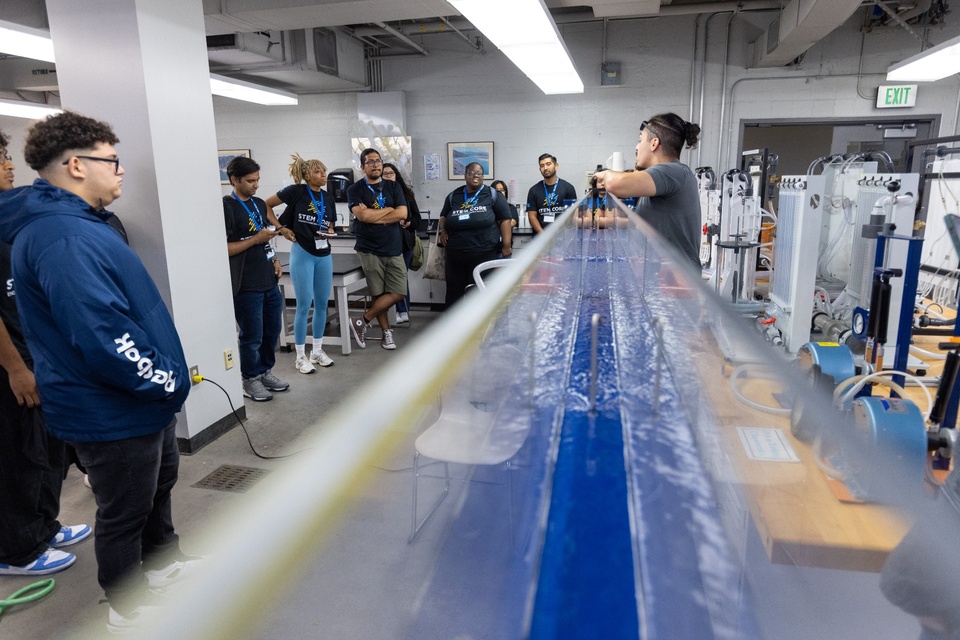
The expo began with a morning tour of the Engineering and Technology building for the Summer Bridge students, highlighting the research and innovations by the College of Engineering, Computer Science, and Technology. The students broke up into groups and rotated through classrooms, laboratories, the Makerspace, and the Circuit Space.
Faculty, students, and interns provided demonstrations that involved AI, robotics, hydrology, concrete, hydraulics, and more.
“A lot of the things we’re learning in the summer program are being researched here,” said Milton Diaz, an ELAC sophomore interested in engineering technology. “It made me want to ask more questions. Every aspect of engineering was covered. It was very engaging.”
In addition to spotlighting the work done at Cal State LA, the expo also impressed to the students the viability and earning potential that comes with an engineering degree.
“Caltrans is a major partner, and they currently have 1,000 job openings that require engineering degrees,” said Hanzel-Sello. “We know there are going to be jobs available.”
During a lunchtime panel, Caltrans’ Jay Satalich told students that the state’s transportation agency is often forced to hire from overseas because of the lack of engineering degrees produced domestically.
“Our engineers are having a hard time finding people,” said the Caltrans supervising transportation surveyor. “The Cal State LA degree is designed to get people into the workforce.”
Growth Sector has supported more than 3,300 community college students across five states. It has placed more than 1,000 students in paid internships.
In addition to Caltrans, the program’s supporters also include such industry leaders as NASA, Lockheed Martin, and Lawrence Livermore National Laboratory.

The pathway participants begin by joining the Summer Bridge program, where, as freshmen, they participate in STEM workshops at their respective community colleges. They are placed in paid internships at four-year colleges during their second year and then apprenticeships in their third year.
At Cal State LA, the second-year students serve their internships under the Summer Making, Academic Prep, and Research for Transfer Students (SMART) program.
“Our students are getting early work experience,” said Gabe Hanzel-Sello, Growth Sector’s national STEM director. “Traditionally, most engineering undergrads get internships maybe following their sophomore or junior year at university. We’re subsidizing interns after their first year at community college with the idea that they graduate with a ton more experience than many of their counterparts.”
The expo began with a morning tour of the Engineering and Technology building for the Summer Bridge students, highlighting the research and innovations by the College of Engineering, Computer Science, and Technology. The students broke up into groups and rotated through classrooms, laboratories, the Makerspace, and the Circuit Space. Faculty, students, and interns provided demonstrations that involved artificial intelligence, robotics, hydrology, concrete, hydraulics, and more.
“A lot of the things we’re learning in the summer program are being researched here,” said Milton Diaz, an ELAC sophomore interested in engineering technology. “It made me want to ask more questions. Every aspect of engineering was covered. It was very engaging.”
In addition to spotlighting the work done at Cal State LA, the expo also impressed to the students the viability and earning potential that comes with an engineering degree.
“Caltrans is a major partner, and they currently have 1,000 job openings that require engineering degrees,” said Hanzel-Sello. “We know there are going to be jobs available.”
During a lunchtime panel, Caltrans’ Jay Satalich told students that the state’s transportation agency is often forced to hire from overseas because of the lack of engineering degrees produced domestically.
“Our engineers are having a hard time finding people,” said the Caltrans supervising transportation surveyor. “The Cal State LA degree is designed to get people into the workforce.”
Growth Sector has supported more than 3,300 community college students across five states. It has placed more than 1,000 students in paid internships.
In addition to Caltrans, the program’s supporters also include such industry leaders as NASA, Lockheed Martin, and Lawrence Livermore National Laboratory.

# # #
California State University, Los Angeles is the premier comprehensive public university in the heart of Los Angeles. Cal State LA is ranked number one in the United States for the upward mobility of its students. Cal State LA is dedicated to engagement, service, and the public good, offering nationally recognized programs in science, the arts, business, criminal justice, engineering, nursing, education, and the humanities. Founded in 1947, the University serves more than 24,000 students and has more than 250,000 distinguished alumni.