
California has begun its move toward a new, innovative model of criminal justice, and Cal State LA will be playing a key role in the transformation.
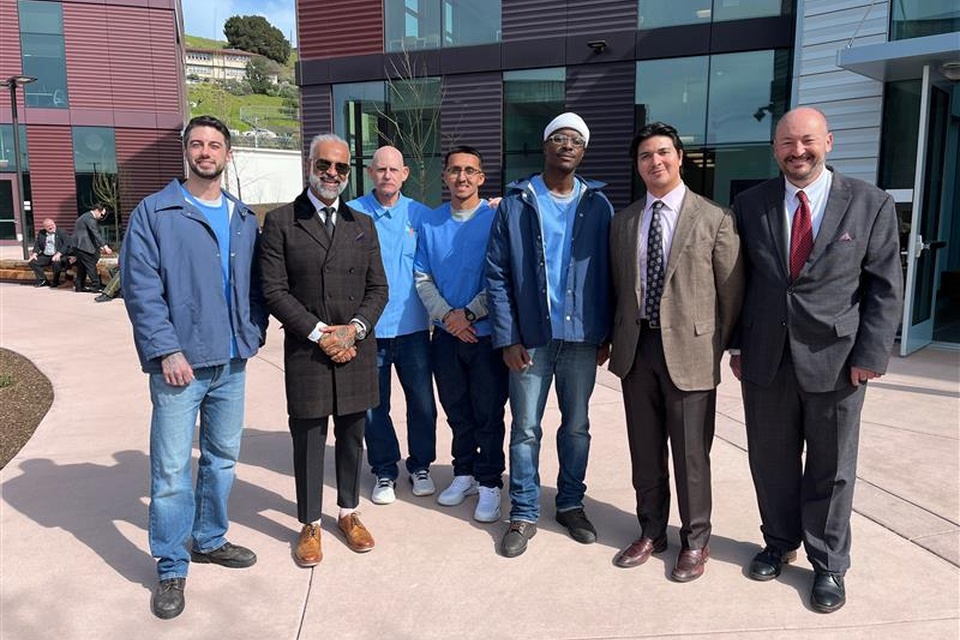
On Friday, Feb. 20, Governor Gavin Newsom held a ribbon-cutting at the newly rebranded San Quentin Rehabilitation Center for a state-of-the-art Learning Center that will be a cornerstone of the California Model, which emphasizes accountability, education, and reentry in the rehabilitation of the state’s incarcerated population.
The 81,000-square-foot San Quentin Learning Center includes an Education Hub building, where Cal State LA’s Prison Graduation Initiative (PGI) will offer courses toward a bachelor’s degree to an inaugural cohort of 35 incarcerated students starting in the fall 2026 semester in August.
“The space is mind-blowing,” said PGI Director Bidhan Roy. “PGI has its own classroom dedicated to our programming and it’s wired with modern technology. It’s an unbelievable space.”
San Quentin, which is located about 400 miles north of Cal State LA in the San Francisco Bay Area, will be the fourth institution where PGI is offered. The program was launched in 2016 at the California State Prison, Los Angeles, in Lancaster as the first in-person bachelor’s degree completion program in the state.
PGI has expanded to also include the California Institution for Men (CIM) and the California Institution for Women (CIW), both in Chino, and to date has graduated more than 70 students. The fourth cohort from Lancaster will graduate about another 20 students in May.
PGI will offer the San Quentin students a Bachelor of Arts in the Applied and Professional Humanities (APH) Option in Liberal Studies. APH is a career-focused program that combines the breadth of the liberal arts with applied, real-world professional training. It is designed to help students build in-demand workforce skills while supporting civic engagement, ethical reasoning, and community well-being.
“The curriculum is very career-focused,” Roy said. “The students obviously want a degree, but they also want to know how the courses can lead to their next steps in life, how they can connect them to their careers.”
Most of the students already reside in San Quentin, but others who qualify for the program will be transferred in from other institutions around the state, including from Lancaster and CIM.
Cal State LA will offer the courses in partnership with Cal State East Bay and San Francisco State. PGI will train 10-12 faculty members from the two Bay Area universities to teach the first cohort, which would be scheduled to graduate by spring 2028.
The program’s growth and success over the past decade perfectly align with the goals of the California Model, which was inspired by the Norway Model’s progressive approach to rehabilitation.
The California Model’s key principles include:
- Normalization: Classrooms replicate non-prison environments to ease reentry into society
- Dynamic security: Emphasizes positive relationships and respectful communication between staff and incarcerated individuals
- Peer mentorship: Trains students to support one another through shared experiences
- Trauma-informed care: Recognizes and addresses the lasting effects of trauma on both staff and students
The San Quentin Learning Center is an important initial component of the California Model.
“Three years ago,” Newsom said during the ribbon-cutting ceremony, “I stood here and promised to turn this symbol of the old system into the crown jewel of a new one. Today, with the opening of the Learning Center, we are proving that rehabilitation and public safety go hand in hand—and that hope is a powerful tool for safer communities.”
The Learning Center, according to the governor’s office, is the “fastest state project in history.” It was built in 18 months at a cost of $239 million in the formerly named San Quentin Prison, which was once one of the state’s most notorious facilities and home to California’s death chamber.
The Learning Center is comprised of three interconnected buildings, whose features include classrooms, an expanded library, and reading spaces; a reentry center that reinforces preparation for release; podcast studios, television facilities, and recording spaces; a multipurpose gathering hall, café, and store; and outdoor classrooms with views of the San Francisco Bay.
Roy said the bidding process to offer courses at San Quentin was competitive, with universities from the California State University and University of California systems and private schools offering compelling cases for themselves.
He added that PGI is ready to take on the challenge of helping the state transition to the California Model.
“San Quentin is high profile, so there is that added pressure,” Roy said. “I think that’s great. I’m excited that Cal State LA has the opportunity to show a different audience what our programming does, who our faculty are, how we go about things.”
Have a story to share?
California State University, Los Angeles is the premier comprehensive public university in the heart of Los Angeles. Cal State LA is ranked number one in the United States for the upward mobility of its students. Cal State LA is dedicated to engagement, service, and the public good, offering nationally recognized programs in science, the arts, business, criminal justice, engineering, nursing, education, and the humanities. Founded in 1947, the University serves more than 22,000 students and has more than 260,000 distinguished alumni.