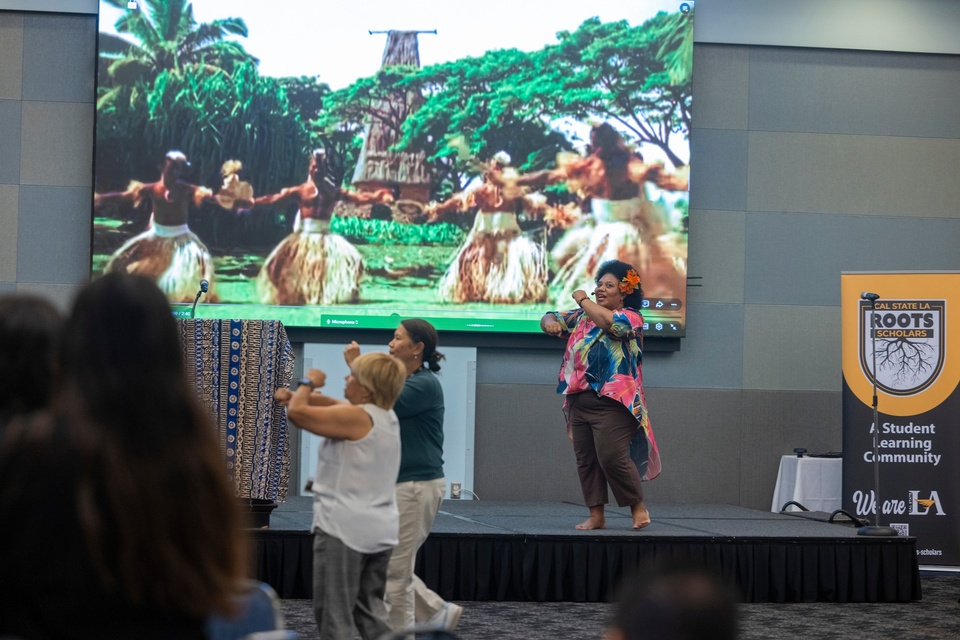
On Thursday, Nov. 12, Cal State LA hosted an interactive Indigenous Native Hawaiian and Pacific Islander (NHPI) Movement and Cultural Practices event that explored dances from Tongan, Hawaiian, and Fijian cultural traditions. The event was funded by the California State University Asian American, Native Hawaiian and Pacific Islander Student Achievement Program (CSU ASAP).
The ROOTed in Togetherness and Strength (ROOTS) Scholars Program at Cal State LA sponsored the afternoon celebration with support from the College of Ethnic Studies. ROOTS is an academic learning community centered on Asian American, Native Hawaiian, and Pacific Islanders histories, cultures, and community experiences.
Trinh Pham, faculty co-director of the ROOTS Scholars Program, said: “Engagement among students from many different cultural backgrounds and identities adds to the richness of the experiences we offer through ROOTS. ROOTS means a great deal to me, and I believe the work we do is extremely important.”
The NHPI event began with a land acknowledgment, a statement recognizing that Los Angeles County occupies land originally cared for by the Tongva, Tataviam, Serrano, Kizh, and Chumash peoples—honoring their ongoing stewardship while recognizing the devastating impacts of settler colonization.
The first dance lesson was given by Malia Otuhiva, who is from the Tongva Nation and is coordinator of Cal State LA’s Asian Pacific Islander Student Resource Center. She explained that Tongan dance is tightly linked to the Four Golden Pillars of Tongan tradition: Faka’apa’apa (mutual respect), Loto tō/Anga Fakatōkilalo (humility), Tauhi Vā (nurturing relationships), and Mamahi’i Me’a (loyalty and passion).
“Dance is more than entertainment,” Otuhiva said. “You might be going to Hawaii or other places where they perform different cultural dances, but it’s important that we don’t look at any type of performance, dance, or song just as something to be entertained by. But, it’s preserving our culture especially with NHPI context, displaying respect between our elders, relations, and just bringing community together. An expression of our identity.”
She taught audience members how to perform tau’olunga, a traditional Tongan solo or small-group dance performed by young women to visually interpret the poetry or lyrics of a song with graceful hand movements.
Up next was Assistant Professor Lani Cupchoy in the Department of Chicana(o) and Latina(o) Studies, who is Kānaka ‘Ōiwi from the nation of Hawaii and greeted everyone with “aloha,” while emphasizing the importance of bringing strong energy when greeting others with this traditional phrase as it translates to “breadth of life.”
“For generations, hula has remained a powerful expression of Hawaiian identity, cultural expression, and cultural resistance,” said Cupchoy. “Hula is simply not just entertainment, as Malia was mentioning earlier, for us it’s a way of transmitting knowledge through mele, or song and chant. The words matter as much as the steps.”
She then gave an overview of Hawaii’s traditions of mele, which are poems, chants, and songs about Hawaii’s origins. Along with other versions of hula, such as Hula kahiko, which predates Western influence on the style of song and dance, she also discussed Hawaii’s continued resistance to colonialism.
“We are still here,” said Cupchoy, who invited volunteers to join her in a hula demonstration.
Concluding the dance demonstrations was Tarisi Vunidilo, assistant professor in the Department of Chicana(o) and Latina(o) Studies, who is Fijian, specifically from Kemundou.
“We are just a dot on the world map, but it’s the center of the universe for me,” she said.
Vunidilo began by explaining that Fiji is an archipelago or a cluster of more than 300 islands with more than 300 dialects, which influence the dances. She then explained the reverence for choreographers, who are honored throughout the Pacific islands for preserving the genealogy of dance within their cultures.
“We acknowledge our choreographers. I think Malia used the work pūnake, and Lani used kuma hula; these are the teachers. And for us in the Pacific, we take them seriously because to become a choreographer you come from your genealogy and you need to know everyone’s genealogy,” she said.
In Fiji, choreographers are called daunivucu. Traditionally, they assemble large groups of more than 100 people for a dance and arrange dancers according to their rank and genealogy, which is a Fijian custom.
Vunidilo then taught students the seasea or meke seasea, a traditional dance performed by women.
The event included a table of artifacts from each culture, including masks, spears, and traditional garments used in the dances. Students were also invited to make leis and take pictures at a photo booth. Lunch featured Hawaiian pancakes, Spam masubi, and an assortment of barbecue skewers.
Alexandria Castro-Spencer, a staff member with the Office of Diversity, Equity, Inclusion, and Belonging, supports the ROOTS Scholars Program and helped facilitate the event. She said, “I think it’s beautiful to see indigenous cultures, especially native Hawaiian, Tongan, and Fijian cultures expressing their cultures through dance.”