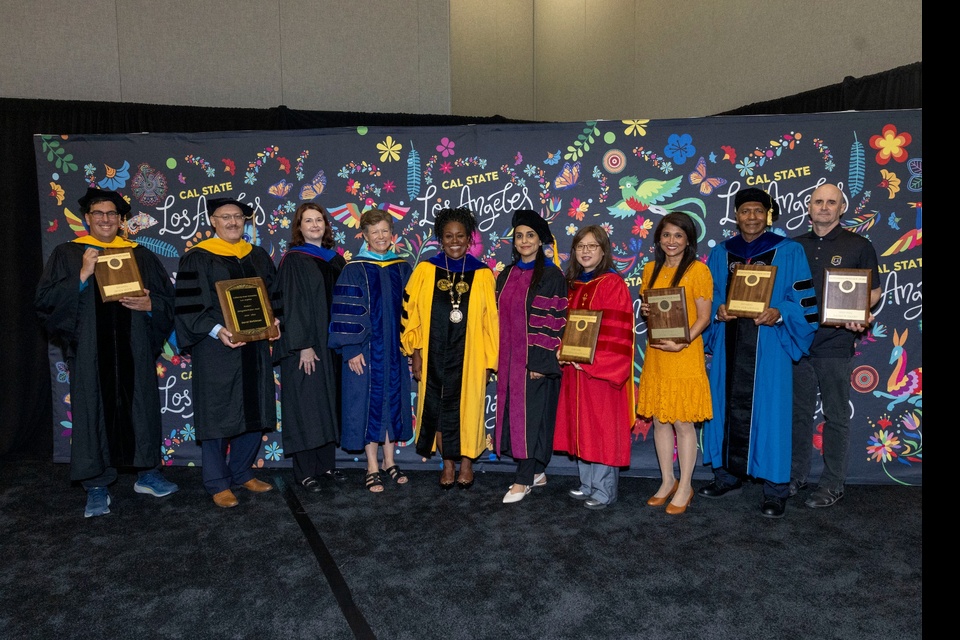
Six Cal State LA faculty members were recognized for excellence in teaching and outstanding achievements during the University Convocation and Investiture on Aug. 18. The annual event marked the start of the academic year and included the investiture of Dr. Berenecea Johnson Eanes as the university’s ninth president.
Professor Anureet Kaur, chair of the Outstanding Professor Awards Selection Committee, introduced the faculty awards during the ceremony. She was joined on stage by President Eanes, Provost Heather Lattimer, and Academic Senate Chair Jessica DeShazo to present the honors.
Four faculty members received the Outstanding Professor Award, and one was recognized with the Outstanding Lecturer Award. These awards celebrate significant accomplishments in scholarly inquiry or creative work, professional contributions, and community service.
Additionally, the President’s Distinguished Professor Award was presented to a previous Outstanding Professor Award recipient. This honor recognizes superlative teaching, exceptional dedication to students, and sustained professional excellence.
PRESIDENT’S DISTINGUISHED PROFESSOR
David Blekhman, professor of technology in the College of Engineering, Computer Science, and Technology, is an internationally recognized expert in hydrogen technology, clean energy, and advanced transportation systems.
Since joining Cal State LA in 2007, Blekhman has demonstrated a strong commitment to academic excellence, student success, and community engagement. He is the founding technical director of the university’s Hydrogen Research and Fueling Facility (HRFF), commissioned in 2011. The HRFF produces hydrogen through electrolysis and serves as a vital hub for education, research, and innovation in zero-emission transportation.
Blekhman’s contributions have earned him some of the most prestigious honors in academia, including the 2023 CSU Wang Family Excellence Award for Outstanding Scholarship—the highest faculty recognition across the 22-campus CSU system—and Cal State LA’s Outstanding Professor Award in 2022. He was also named a 2019-20 Fulbright Distinguished Chair in Alternative Energy Technology at Chalmers University in Sweden.
He has secured more than $36 million in grant funding as principal investigator, co-PI, and senior personnel. Recent awards include $7 million from the U.S. Department of Transportation, $2.2 million from the South Coast Air Quality Management District (AQMD) for hydrogen infrastructure, and $500,000 from the California Energy Commission for workforce development. In 2025 alone, he received three grants totaling more than $600,000.
Through his leadership, the HRFF has trained hundreds of students and hosted more than 12,000 visitors, including first responders, industry leaders, and international delegations. He has led the development of the Sustainable Energy and Transportation academic concentration, guiding it to accreditation and integrating real-world experience through campus “Living Labs.”
From 2011 to 2018, Blekhman directed Cal State LA’s EcoCAR teams, which reengineered vehicles like the Chevrolet Malibu and Camaro into plug-in hybrids. These efforts earned multiple national awards, including the Green Leadership Award from Los Angeles County and the Clean Air Award from the South Coast AQMD. He is also the co-lead of Cal State LA’s Battery Workforce Challenge student team.
Internationally, he has mentored students from Europe and built research collaborations with institutions in Sweden, Belgium, and Italy. His thought leadership extends to industry media as a Forbes online contributor on hydrogen transportation, with his articles garnering over 60,000 views.
A South Pasadena resident, Blekhman holds bachelor’s and master’s degrees in thermal physics from Saint Petersburg State Polytechnical University and a Ph.D. in mechanical engineering from SUNY Buffalo.
OUTSTANDING PROFESSORS
Eun-Young (Elaine) Kang is a professor of computer science in the College of Engineering, Computer Science, and Technology (ECST). She has served as chair of the Department of Computer Science since 2019.
A strong advocate for inclusive computing education, Kang has secured more than $5.5 million in external funding as a principal or co-principal investigator to support equity-focused initiatives.
Kang’s current projects include the National Science Foundation-funded Broadening Participation in Computing grant, which supports Latinx student retention through socially responsible computing and early community engagement; the Center for Inclusive Computing Transfer Pathway Project, aimed at removing barriers for transfer students in computing; and the Computer Science Supplementary Authorization program, which she launched and continues to direct to train K–12 teachers—particularly in underserved districts—to teach computer science.
Kang is passionate about teaching in the areas of artificial intelligence, machine learning, multimedia data, and game development. She has also supervised numerous senior design capstone projects in partnership with NASA’s Jet Propulsion Laboratory, Mozilla, and other public and private organizations, and has mentored student teams in national-level game competitions. Through these efforts, she helps students translate classroom learning into real-world applications.
As department chair, Kang has overseen major revisions to both undergraduate and graduate programs, led a successful ABET reaccreditation, expanded industry partnerships, and increased faculty diversity through strategic hiring. She represents her department in the Computing Alliance of Hispanic-Serving Institutions and created an online community to support Latinx students in computer science.
Her work has been recognized with the Cal State LA Distinguished Women Award, and she has been selected as a grand marshal for the College of ECST during the university’s Commencement. She serves on university-wide committees and is a frequent reviewer for the National Science Foundation, CSU computer science programs, and professional journals and conferences.
She is an active member of many professional organizations and is a founding member of the Institute for Narrative Arts, Technology, and Research. A resident of Los Angeles, Kang earned her Ph.D. in computer science from the University of Southern California.
Devika Hazra is a professor of economics and statistics in the College of Business and Economics.
A scholar, educator, and advocate, Hazra’s work focuses on gender-based violence, economic inequality, and structural injustice, with the goal of informing both academic inquiry and real-world solutions.
Trained as an applied microeconomist, Hazra leads interdisciplinary research that examines the economic and institutional roots of violence against women and marginalized communities. Her projects—supported by the Haynes Foundation, Gates Foundation, Bank of America, and the Center for California Studies—combine quantitative and qualitative methods to address pressing social and economic issues. She was also honored with the Provost Faculty Fellow award at Cal State LA.
A committed educator, Hazra teaches undergraduate and graduate courses in microeconomics, macroeconomics, monetary policy, and development economics. She brings inclusive and innovative teaching practices to the classroom and has helped lead efforts to align curriculum with career readiness as a faculty fellow of the Center for Effective Teaching and Learning. She mentors students at Cal State LA, as well as other students through the Committee on the Status of Women in the Economics Profession, an initiative of the American Economic Association.
Hazra plays a vital role in campus leadership. She serves as vice chair of the Academic Senate and has previously served as executive secretary. She co-directed the college’s Financial Fitness Program, led the Gateway to Employment initiative, and supported faculty scholarship as research coordinator for the college.
Her work also extends far beyond campus. As a research fellow with the California Research Bureau and the Los Angeles Economic Equity Accelerator and Fellowship, Hazra collaborates with policymakers and community organizations to address inequality across the state. She volunteers as a certified domestic violence counselor and prevention specialist with nonprofits, such as Peace Over Violence, the East L.A. Women’s Center, and the Downtown Women’s Center. She also serves as a mediator with the Neighborhood Justice Panel under the L.A. City Attorney’s Office.
A Pasadena resident, Hazra earned her Ph.D. in economics from Texas A&M University.
Rupa Purasinghe is a professor of civil engineering in the College of Engineering, Computer Science, and Technology (ECST). He has served as chair of two departments, civil engineering and technology, where he led strategic academic and industry-aligned initiatives to strengthen applied learning, interdisciplinary collaboration, and workforce development.
Since joining Cal State LA, Purasinghe has distinguished himself as a dedicated educator, scholar, and leader in engineering and technology education. His work focuses on bridging traditional engineering disciplines with emerging technologies to prepare students for the evolving demands of modern infrastructure and the industrial sector. Under his leadership, the Department of Civil Engineering and the Department of Technology have expanded their curriculum and industry partnerships, emphasizing innovation, sustainability, and real-world problem-solving.
A champion of experiential learning, Purasinghe has played a key role in integrating hands-on lab experiences, project-based coursework, and capstone design into both civil engineering and technology programs. He is also actively involved in accreditation efforts, program assessment, and continuous improvement processes, ensuring that students receive a rigorous, relevant, and forward-thinking education.
Purasinghe has served as a principal investigator and co-investigator on several grants supporting curriculum development, workforce training, and STEM research and outreach. His research interests include engineering materials, infrastructure sustainability, engineering education, and the application of digital tools in engineering. He has published and presented widely on these topics and maintains strong ties with industry and professional organizations to align academic training with career opportunities for students.
As department chair, Purasinghe has led initiatives to modernize facilities, recruit diverse faculty, and strengthen collaborations across ECST and with community college and high school partners. He is committed to expanding access and pathways into high-demand engineering and technology fields, particularly for first-generation students.
Purasinghe is known for his student-centered approach, mentoring countless undergraduate and graduate students in their academic, research, and career development. He regularly advises student teams participating in national engineering competitions and industry-sponsored projects.
He brings a global perspective to his work, informed by academic and professional experience both in the United States and internationally. He resides in Alhambra and received his Ph.D. in engineering from Case Western Reserve University and M.S. in applied science from Portland State University. His bachelor’s degree is from the University of Peradeniya, Sri Lanka.
Patrick Sharp is a professor of liberal arts in the College of Arts and Letters. A faculty leader since 2001, he co-led the development of the Liberal Studies program’s interdisciplinary curriculum, securing department status in 2004. He has served as associate chair, head of curriculum, and head of advisement, before becoming the department’s first chair. He also directed the university’s Writing Proficiency Exam for three years.
Sharp has held additional leadership roles, including interim associate dean of the College of Arts and Letters, special assistant to the dean, and faculty athletics representative. He supported the Honors College through a leadership transition and played a foundational role in two major campus initiatives: EagleCon, a convention on speculative media, and the Prison Graduation Initiative. He currently leads the Liberal Studies Program at the California Institution for Women in Chino, where he teaches and mentors faculty working with incarcerated students.
An award-winning scholar, Sharp is the author of Savage Perils, cited across disciplines and recognized as foundational to the field of indigenous futurism. His co-edited anthology Sisters of Tomorrow was named feminist anthology of the year by the Popular Culture Association. His monograph Darwinian Feminism and Early Science Fiction was selected as a Choice Outstanding Academic Title. His recent work on Indigenous science fiction appears in The Routledge Handbook of CoFuturisms.
He serves as co-editor of the New Dimensions in Science Fiction series and sits on the editorial board of Science Fiction Studies. In 2024, he co-founded the nonprofit Speculative Fiction Across Media, where he serves as executive director. He also contributed to the Academy Museum of Motion Pictures’ Cyberpunk exhibition and its accompanying publication.
Sharp’s teaching has developed key courses on interdisciplinary investigation, gender and science, and speculative fiction. His writing guide, now in its third edition, is widely used by students and instructors alike. He continues to lead curricular development while mentoring students across a range of educational and research experiences.
A Los Angeles resident, he received his Ph.D. in English from the University of California, Santa Barbara.
OUTSTANDING LECTURER
Dinur Blum is an instructor in sociology in the College of Natural and Social Sciences.
Blum’s research focuses on student-athlete challenges and successes in the classroom, the social causes of and solutions to mass shootings in the United States, the spread of misinformation and disinformation, and COVID-19’s effects on U.S. higher education. He has conducted research and delivered presentations on these topics at regional, national, and international conferences and workshops, and has participated in multiple news interviews related to his expertise.
Blum is a committed educator who dedicates countless hours to mentoring students so they can excel academically and professionally. His students continue to succeed because of their efforts, alongside his commitment and enthusiasm for sociology and criminology.
Blum actively participates in and contributes to workshops offered by the Center for Effective Teaching and Learning (CETL) and the Association of College and University Educators (ACUE). He was part of CETL’s inaugural Career-Engaged Departments program, focusing on making sociology courses more professionally relevant for students, and has earned ACUE’s certificate in effective college instruction.
Blum also co-hosted Learning Made Easier with Dr. Adam G. Sanford. The podcast is designed to help both students and faculty thrive in the classroom, and students have responded favorably and developed academically and professionally with its guidance.
Prior to Cal State LA, he tutored K-12 students and taught a wide range of sociology courses at several educational institutions, including the University of California, Riverside, and the University of Connecticut.
Blum has earned teaching awards from UC Riverside and the Pacific Sociological Association for his efforts in and out of the classroom. Because of his work on mass shootings, Blum was also one of a select group of 16 faculty members nationwide who participated in RAND’s Pardee Graduate School of Public Policy.
Blum earned his Ph.D. in sociology, with emphases on criminology, socio-legal studies, and institutions and organizations from UC Riverside; his master’s degree in sociology from the University of Connecticut; and his bachelor’s degree in sociology and political science from UC Davis. He is an Ontario resident.
# # #
California State University, Los Angeles is the premier comprehensive public university in the heart of Los Angeles. Cal State LA is ranked number one in the United States for the upward mobility of its students. Cal State LA is dedicated to engagement, service, and the public good, offering nationally recognized programs in science, the arts, business, criminal justice, engineering, nursing, education, and the humanities. Founded in 1947, the University serves more than 24,000 students and has more than 250,000 distinguished alumni.