
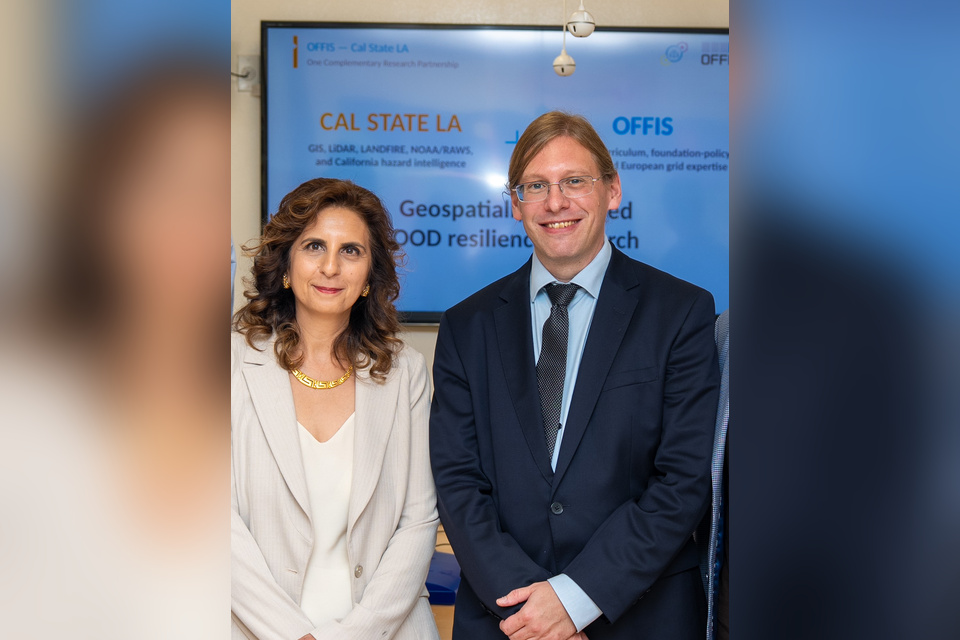
Cal State LA and OFFIS Institute for Information Technology in Oldenburg, Germany, have established a new research and academic partnership focused on artificial intelligence, geospatial analysis, and the resilience of critical infrastructure. The collaboration brings together two institutions with complementary strengths to address challenges facing energy systems and other essential services, including natural hazards and cyber-physical threats.
This partnership reflects the shared vision of Vivian Sultan, a professor of information systems at Cal State LA, and Eric MSP Veith, scientific director of the research and development division for energy at OFFIS. Both are recognized for their leadership in geospatial science, artificial intelligence, and infrastructure resilience. Their commitment to advancing international research and creating meaningful opportunities for students and faculty provided the foundation for this partnership and shaped the direction of its first joint initiative.
The agreement was supported by Arun Aryal, chair of the Department of Information Systems, and Seiji Steimetz, dean of the College of Business and Economics. Sultan, Aryal, and Steimetz signed the memorandum of understanding on behalf of Cal State LA.
“Thank you for the extraordinary work that has gone into building this partnership,” said Heather Lattimer, provost and vice president for Academic Affairs at Cal State LA. “It is exciting to see such strong collaboration taking shape, and I look forward to following the progress of this important initiative.”
Under the agreement, Sultan and Veith will serve as principal liaisons. They will coordinate joint activities, maintain communication between the institutions, and guide the collaboration as it expands into additional research and educational programs.
Veith visited Cal State LA from Sept. 9 through Oct. 7. On Sept. 30, he presented a lecture on “AI Beyond the Training Distribution: What Fridges and Wildfires Have in Common and What We Can Do About It.”
“My time at Cal State LA has been one of the most rewarding experiences of my career,” Veith said. “The support, collegiality, and shared sense of purpose have made this collaboration truly special. OFFIS has turned computer science research into practical solutions for more than 35 years, and our energy division is among the largest centers for energy informatics in Europe. I am grateful for the opportunity to contribute to this partnership, and I look forward to continuing our work and deepening the ties between our institutions.”
The first proposed project under the partnership is GUARDIAN, which stands for Geospatial Red-Teamed AI Decision Support for Resilient Critical Infrastructure Operation under Hybrid and Natural Hazards. The team is preparing a proposal for the North Atlantic Treaty Organization’s (NATO) Science for Peace and Security Programme. The project aims to combine geospatial intelligence with advanced AI methods to explore how critical infrastructure can better withstand natural hazards and hybrid threats. The research would focus on how AI agents respond to unfamiliar, high-impact conditions rather than only situations encountered during training.
“It has been a privilege to work alongside colleagues who share a commitment to advancing scientific research and strengthening critical infrastructure,” Sultan said. “Our collaboration with OFFIS brings together expertise that can make a real difference for communities and infrastructure operators facing increasingly complex hazards. GUARDIAN is only the beginning, and I am excited for what we will accomplish together.”
The collaboration draws on Cal State LA’s expertise in geographic information systems, spatial analytics, energy informatics, and California hazard data. OFFIS contributes its strengths in artificial intelligence, simulation, cyber-physical systems security, and European power-grid research. Together, these capabilities create a strong foundation for connecting location-specific hazard knowledge with advanced methods for testing and improving infrastructure resilience.


