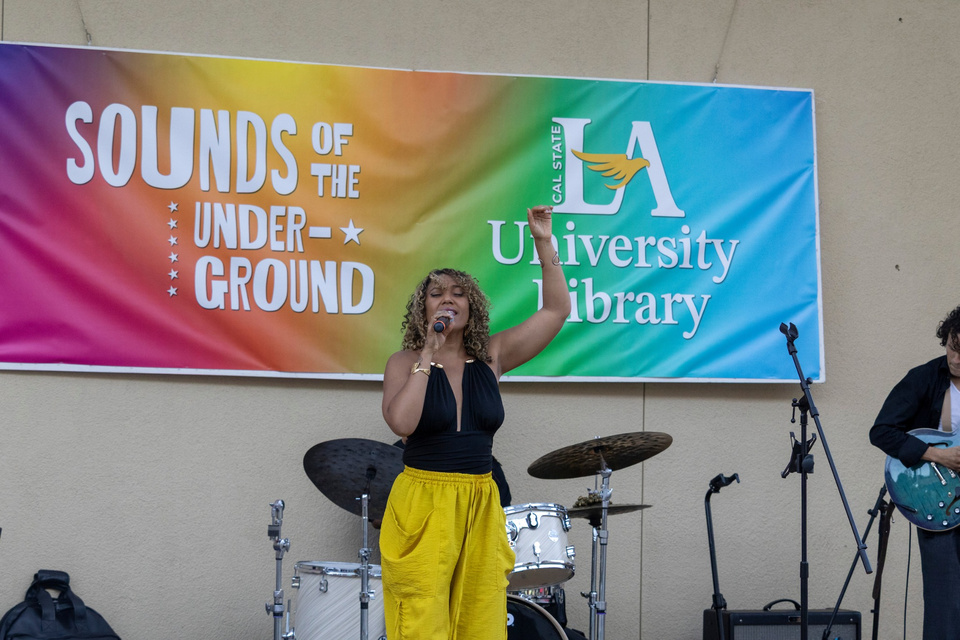
The University Library’s Special Collections and Archives at Cal State LA celebrated its fourth annual Sounds of the Underground event, themed “Keeping the Music Alive,” Nov. 3-5.
The three-day event highlighted the diverse sounds and communities that have shaped Los Angeles’ underground music scene.
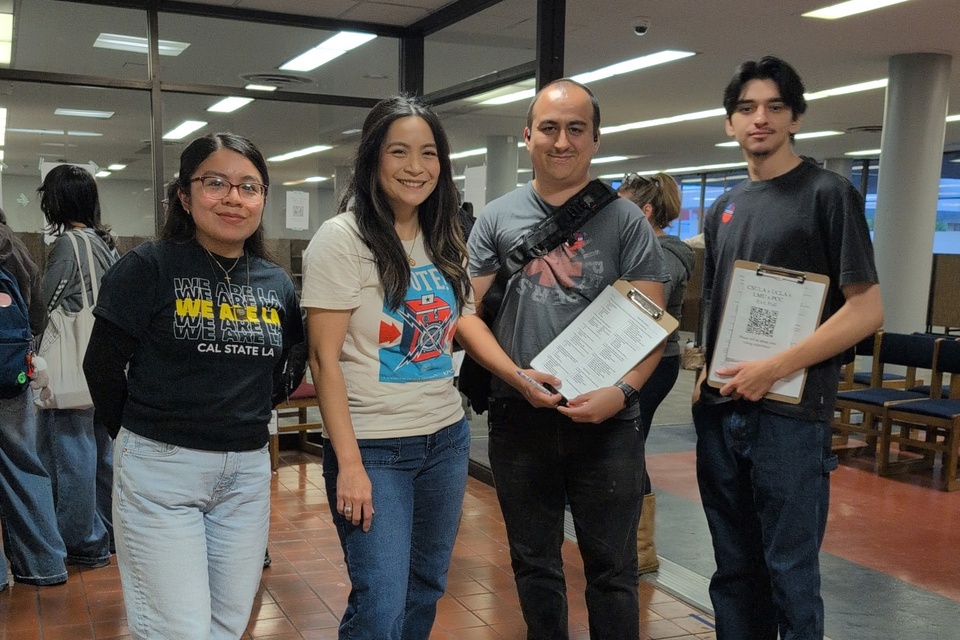
Communications Strategist and Event Coordinator Kelsey Brown; Head of Special Collections and Archives Azalea Camacho; and Ethnic Studies Librarian Lettycia Terrones make up the small but mighty library team behind the music magic.
The event was sparked by an interest in collecting stories from underground music scenes. Over the event’s history, organizers have archived lesser-known stories and materials, including live music recordings and concert tickets.
“This came about because we were part of different types of underground music scenes growing up, and so those scenes either kind of evolve over time, but don’t really exist anymore,” Camacho said. “And, so the idea was to collect those stories of the everyday person.”
Camacho discovered the Los Angeles’ club scene through her older brother, who introduced her to goth, new wave, and rockabilly music.
Brown grew up attending rehearsals for her parents’ synth-pop band and getting quizzed on classic rock. Live music became a big part of her college experience, inspiring her to bring that feeling to Cal State LA.
The first day of the event kicked off with a keynote conversation between Samuel Lamontagne, assistant professor of music and Black studies at the University of California, Riverside, and Maia, a multi-instrumentalist and member of the Pan Afrikan Peoples Arkestra (PAPA).
Founded in 1961 by American jazz pianist, composer, and LA music legend Horace Tapscott, PAPA is a community-based jazz ensemble focused on unity, racial liberation, and musical creativity.
Lamontagne co-edited Leave It for the Children: A Visual History of the Pan Afrikan Peoples Arkestra, with Darol Olu Kae. Published by Angel City Press, the book is a visual archive of the jazz ensemble’s history and legacy.
“When you look at the history of Black people, music is an extremely important practice, not just in terms of creative practice, but in terms of how it connects to the consciousness of Black people, how it connects to, you know, the intellectual,” Lamontagne said.
Lamontagne said you cannot understand the history and importance of Black music without love for the people who made it.
“So if you actually care about Black music, and if you actually understand Black music, then you would understand and learn how to respect Black people, and you know, love Black people, too,” Lamontagne said.
The music research symposium took place on the second day, featuring researchers, artists, archivists, and community historians to share their knowledge and love for art.
Cal State LA Chicanx and Latinx studies graduate student Jessie Gomez and her bandmate Michelle Martinez presented “DIY-Versity-QTPOC Music as a Pedagogy of Resistance” during the symposium. Their lecture explored do-it-yourself music by queer and transgender people of color, specifically in the Inland Empire, and was followed by a live music performance.
Their band, Mwauhshell, was established in 2014, and they’ve been playing on and off for a while. They describe their music as the unconventional song structures of experimental punk with the heavy but dreamy reverb of shoegaze.
“Punk is whatever form of music you want to put out there where you’re standing up for something, where you’re giving a message,” Martinez said. “Whatever it is that you’re saying and you’re speaking up for yourself and for your community, that’s punk.”
On the final day, community archiving activities at the campus library encouraged attendees to donate or digitize music memorabilia, including flyers, concert tickets, photos, and cassettes, preserving underground music histories for future generations.
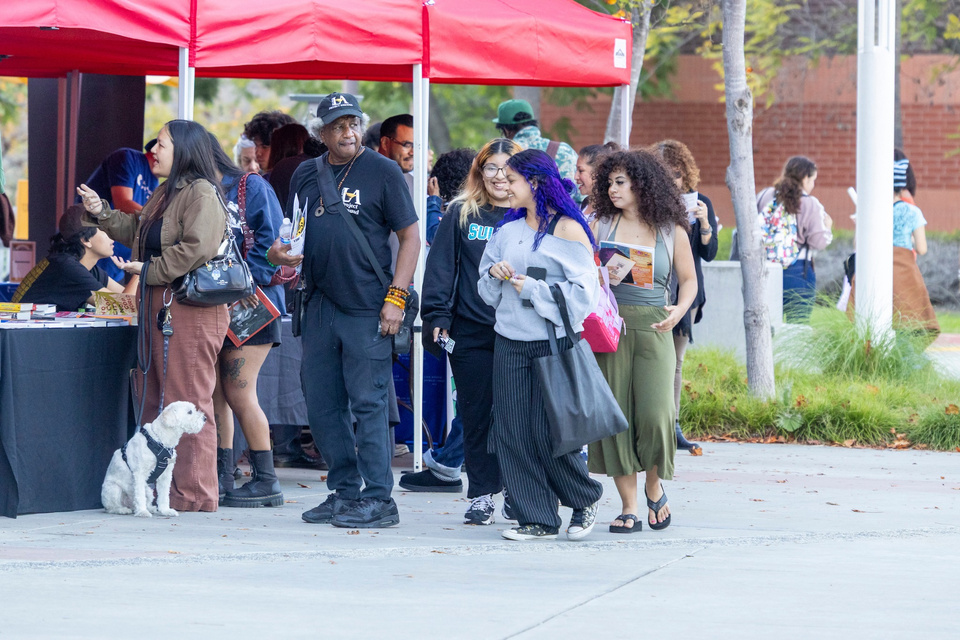
The music festival was live at the University-Student Union Plaza, featuring performances by Samuel Lamontagne, T-Kay, Colloboh, Melo Gía, and PAPA. The festival also featured booths from community partners, such as Amoeba Music, Angel City Press, and It’s-In-Scope.
Marvin James, founding archive caretaker of It’s-In-Scope, a collective learning and archiving experiment, said his idea was based on a commitment to what we can learn from study, history, and community.
“I think it helps identify not only, like, patterns of things that have maybe gone wrong, but also, like, ancestors [and] elders have also offered some pretty clear direction of what to do and how to create more liberated conditions for folks,” James said.